
Jezebel in the Bible: Royal Manipulation, Religious Warfare, and Prophetic Judgment
Key Takeaways
- Jezebel in the Bible was primarily condemned for promoting Baal worship over Yahweh worship in ancient Israel, not for sexual immorality as commonly misunderstood.
- As a Phoenician princess who married King Ahab, Jezebel maintained her religious identity and established Baal worship in Israel, representing a fundamental threat to Israel’s covenant relationship with Yahweh.
- Jezebel’s dramatic death in 2 Kings 9, where she was thrown from a window and her body eaten by dogs, fulfilled Elijah’s prophecy and served as divine retribution in the biblical narrative.
- The term ‘Jezebel spirit’ in modern charismatic Christianity combines the historical queen from 1 Kings with the symbolic Jezebel mentioned in Revelation 2:20, often applied as a gendered accusation against women in leadership.
- Modern misapplications of the ‘Jezebel’ label have transformed her from a powerful religious and political figure into a problematic stereotype used to control women in religious communities.
- Alternative scholarly interpretations view Jezebel as a complex historical figure whose negative portrayal served the theological purposes of biblical writers concerned with exclusive Yahweh worship.

Who Was Jezebel in the Bible and Why Does She Still Matter Today?
The biblical Jezebel emerges in 1 Kings as a Phoenician princess who married Ahab, king of Israel’s northern kingdom, a political alliance that brought religious warfare to ancient Israel’s doorstep. When Ahab told Jezebel about Elijah’s slaughter of Baal’s prophets, she swore vengeance against the prophet in explicit terms: “May the gods do to me and more also, if I do not make your life as the life of one of them by this time tomorrow” (1 Kings 19:2). This wasn’t merely personal revenge: it was theological combat between Baal worship and Yahweh worship, played out on the stage of royal politics.
Cultural, Religious, and Psychological Echoes of Jezebel’s Legacy
The Jezebel archetype has evolved far beyond its biblical origins. In Christian theology, especially in charismatic traditions, the term “Jezebel spirit” describes a manipulative, controlling spiritual influence that operates through sexual immorality and false religious authority. The woman Jezebel mentioned in Revelation 2:20, who teaches believers to “eat food sacrificed to idols and to commit sexual immorality,” reinforced this theological construct, creating a transhistorical archetype of feminine rebellion against divine authority.
Here’s what’s fascinating: the Hebrew text presents Jezebel not primarily as sexually immoral (contrary to modern assumptions), but as politically ruthless and religiously devoted to foreign gods. Her primary conflict with Yahweh worship centered around her unwavering support for Baal, the Phoenician nature god associated with fertility, storms, and agricultural abundance.
What This Article Will Explore About Jezebel in the Bible
I’ll examine the biblical narrative surrounding Jezebel from multiple angles, historical, theological, linguistic, and contemporary. We’ll explore who Jezebel was according to the biblical text, how manuscript traditions shaped her portrayal, what archaeological evidence reveals about her historical context, and how her image has been used (and misused) throughout religious history.
As scholar Janet Howe Gaines has observed in Biblical Archaeology Review, the portrayal of Jezebel reflects the biblical writers’ theological concerns more than objective historical reporting. The Hebrew Bible constructs her as the paradigmatic opponent of Yahweh worship, a theological necessity for a narrative centered on covenant faithfulness. Understanding this context helps us recognize how ancient religious conflicts shape our contemporary spiritual language, sometimes in problematic ways.
The Identity of Jezebel in the Bible
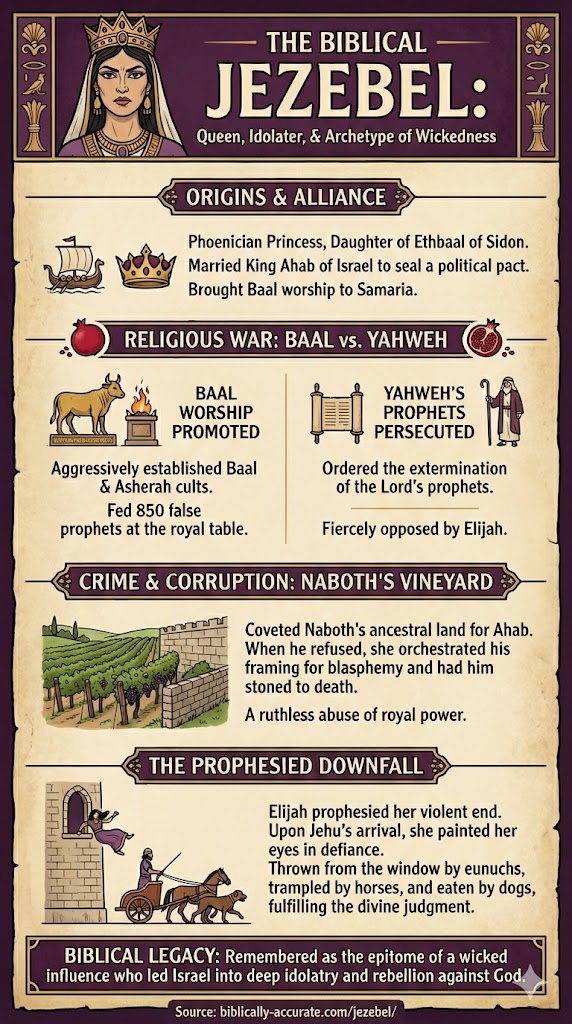
The biblical text introduces Jezebel with immediate theological concern: “Ahab son of Omri did more evil in the eyes of the LORD than any of those before him. He not only considered it trivial to commit the sins of Jeroboam son of Nebat, but he also married Jezebel daughter of Ethbaal king of the Sidonians, and began to serve Baal and worship him” (1 Kings 16:30-31). This framing immediately positions Jezebel not as a complex political figure, but as the embodiment of religious apostasy.
Jezebel’s Background: Daughter of a Phoenician King
The Hebrew text identifies Jezebel as bat-‘Et̲ba’al melek̲ Ṣidōnîm (בַת־אֶתְבַּעַל מֶלֶךְ צִידֹנִים), daughter of Ethbaal, king of the Sidonians. This isn’t merely genealogical information: it’s theological context. The name Ethbaal itself means “with Baal” or “Baal is with him”, a theophoric name that signaled religious allegiance to the Phoenician deity.
Extra-biblical sources, particularly the writings of Josephus who quotes the Phoenician historian Menander, identify her father as Ithobaal I, a priest of Astarte who seized the throne of Tyre. This would make Jezebel a Tyrian princess rather than Sidonian, though the biblical writers often used “Sidonian” as a general term for Phoenicians.
As a royal daughter from a Phoenician dynasty, Jezebel would have been raised in the worship of Baal and Asherah, with their elaborate temples, professional priestly class, and royal endorsement. She wasn’t simply bringing foreign religious ideas to Israel, she was bringing an entire religious-political system.
Marriage to King Ahab: Political Alliance or Spiritual Downfall?
When Jezebel married Ahab king of Israel, the union represented standard ancient Near Eastern diplomacy, political alliances sealed through royal marriages. The northern kingdom of Israel, separated from Jerusalem and the Davidic dynasty, needed commercial and military allies against regional threats, particularly the growing Aramean powers.
What makes this marriage unique is how the biblical writers frame it not as wise statecraft, but as covenant betrayal. Ahab’s decision to marry Jezebel resulted in his worship of Baal. The text states: “He set up an altar for Baal in the temple of Baal that he built in Samaria. Ahab also made an Asherah pole and did more to arouse the anger of the LORD, the God of Israel, than did all the kings of Israel before him” (1 Kings 16:32-33).
The Hebrew text employs specific theological language here, Ahab vayya’avōd (וַיַּעֲבֹד, “served”) Baal and vayyištaḥû(וַיִּשְׁתַּחוּ, “bowed down”) to him. These are covenant terms elsewhere used to describe proper worship of Yahweh, now directed toward a foreign deity. For the biblical writers, this marriage wasn’t merely diplomatic, it was apostasy.
Religious Conflict: Baal Worship vs. Yahweh Worship in 1 Kings
The clash between Baal worship and Yahweh worship forms the theological heart of Jezebel’s narrative. When the text states that Jezebel “killed the prophets of the LORD” (1 Kings 18:13), it portrays her as engaged in theological warfare. Baal, as a nature god associated with rain and fertility, represented a powerful theological alternative to Yahweh in an agricultural society dependent on seasonal rains.
The Hebrew Bible presents the ultimate showdown between these competing religious systems on Mount Carmel, where Elijah challenged the prophets of Baal to a theological contest, calling down fire from heaven. The text tells us there were 450 prophets of Baal and 400 prophets of Asherah “who eat at Jezebel’s table” (1 Kings 18:19).
This detail, eating at the queen’s table, isn’t incidental. It indicates royal patronage and official status. Jezebel wasn’t merely practicing private devotion: she was establishing an alternative state religion with institutional support. The Mount Carmel confrontation ends with Elijah’s victory and the slaughter of Baal’s prophets, leading to Jezebel’s infamous threat against the prophet Elijah.
What’s often missed in casual readings is that this religious conflict wasn’t simply theological, it was existential for both sides. For the Yahwistic prophets, Baal worship threatened Israel’s covenant identity and security. For Jezebel, raised in Phoenician royal religion, the attack on Baal’s prophets represented an assault on her cultural heritage, religious identity, and royal prerogative.
The Jezebel Spirit: Theology, Symbolism, and Modern Usage
The concept of a “Jezebel spirit” represents one of the most significant theological afterlives of the biblical queen. While not explicitly mentioned in the biblical text in these terms, this spiritual diagnosis emerged from charismatic Christian interpretations of Revelation 2:20, where Jesus addresses the church in Thyatira: “Nevertheless, I have this against you: You tolerate that woman Jezebel, who calls herself a prophet. By her teaching she misleads my servants into sexual immorality and the eating of food sacrificed to idols.“
What Is the Jezebel Spirit? A Modern Interpretation Rooted in Scripture
The theological construct of a “Jezebel spirit” links the historical Jezebel of the Hebrew Bible with the symbolic Jezebel of Revelation, creating a spiritual archetype of rebellion against divine authority. In contemporary charismatic theology, this spirit manifests through several characteristics:
- False prophecy and teaching – Just as the Revelation Jezebel “called herself a prophet,” this spirit supposedly manifests through illegitimate spiritual authority
- Sexual immorality – Drawing from Revelation’s accusation rather than the Hebrew Bible’s portrayal, which never explicitly accuses Jezebel of sexual misconduct
- Idolatry – Both Jezebels encouraged worship practices contrary to orthodox faith
- Manipulation and control – Derived from Jezebel’s political maneuvering in the Naboth incident
- Opposition to true prophetic voices – Based on her persecution of Yahweh’s prophets and threats against Elijah
Here’s what’s problematic: this theological construct collapses distinct biblical narratives separated by nearly a millennium and different literary genres. The Hebrew term used for Jezebel in 1 Kings (‘izevel) becomes in Revelation’s Greek a symbolic name (Iezabel) applied to a woman teaching in a first-century church context. While the Revelation author clearly intended to evoke the Old Testament queen, modern interpretations often fail to recognize the rhetorical function of this naming.
Spiritual Warfare and the Jezebel Spirit in Charismatic Movements
In contemporary charismatic Christianity, the concept of the “Jezebel spirit” has become a powerful diagnostic tool within spiritual warfare frameworks. Books, conferences, and ministries dedicated to identifying and combating this spirit have proliferated since the 1980s, with notable works like Francis Frangipane’s “The Three Battlegrounds” and John Paul Jackson’s “Unmasking the Jezebel Spirit” codifying this theology.
This spiritual construct operates through a particular hermeneutic that:
- Treats biblical narratives as revealing transhistorical spiritual principles
- Assumes demonic personalities maintain consistent manifestation patterns throughout history
- Interprets contemporary situations through biblical archetypes
The Holy Spirit, in this framework, reveals the presence of the Jezebel spirit to those with spiritual discernment, particularly when confronting issues of church leadership, sexual ethics, and doctrinal purity.
What deserves critical examination is how frequently this spiritual diagnosis falls along gendered lines. Women in leadership positions who challenge male authority often find themselves labeled with the “Jezebel spirit,” particularly in more patriarchal religious contexts. The biblical Jezebel, a foreign queen who wielded genuine political power, becomes a cautionary archetype applied to women who assert authority in religious spaces.
This interpretation reveals more about modern gender anxiety than ancient Near Eastern history. The Hebrew Bible’s concern was primarily Jezebel’s promotion of Baal worship, not her gender. Her royal status made her religious influence particularly threatening to Yahwistic exclusive monotheism. By transforming this theological conflict into a gendered spiritual archetype, contemporary applications often miss the original religious and political dimensions of the text.
Key Events in Jezebel’s Life According to the Bible
The biblical narrative presents several pivotal moments in Jezebel’s life that reveal her character, power, and ultimate fate. These episodes, crafted by the biblical writers with theological purpose, have shaped her enduring legacy.
The Naboth Vineyard Incident and Her Abuse of Royal Power
1 Kings 21 presents the most damning portrait of Jezebel’s character through her orchestration of Naboth’s death to acquire his vineyard for Ahab. When Ahab told Jezebel about Naboth’s refusal to sell his ancestral vineyard, her response reveals her understanding of royal prerogative: “Is this how you act as king over Israel? Get up and eat. Cheer up. I’ll get you the vineyard of Naboth the Jezreelite” (1 Kings 21:7).
The Hebrew text emphasizes her actions through a sequence of verbs that highlight her agency: “she wrote letters (וַתִּכְתֹּב) in Ahab’s name… she sent (וַתִּשְׁלַח) the letters to the elders…” (1 Kings 21:8). Jezebel writes letters in the king’s name, arranges false witnesses, and engineers a judicial murder through a perversion of legal process.
What’s fascinating is how this episode reflects Phoenician rather than Israelite legal understanding. Jezebel’s approach suggests she viewed royal authority as absolute, without the covenant limitations recognized in Israelite legal tradition. The vineyard represented Naboth’s naḥalat ‘avot (נַחֲלַת אֲבוֹת, “ancestral inheritance”), land understood as an inalienable divine gift to Israelite families. By treating it as a commodity subject to royal acquisition, Jezebel violated fundamental covenant principles.
When Jezebel told Ahab, “Get up and take possession of the vineyard of Naboth” (1 Kings 21:15), she demonstrated a worldview fundamentally at odds with the theological foundations of Israelite society. Her actions provoke one of the most severe prophetic condemnations in the Hebrew Bible, as Elijah pronounces divine judgment on both Ahab and Jezebel.
Her Dramatic Death: 2 Kings 9 and the Fulfillment of Prophecy
Jezebel’s death scene in 2 Kings 9:30-37 represents one of the most dramatic fulfillments of prophetic judgment in the Hebrew Bible. After Ahab died in battle, Jezebel lived on, maintaining influence through her son Joram’s reign. When the military commander Jehu staged his coup, killing Joram, he rode toward Jezreel where Jezebel awaited.
The text presents Jezebel’s final moments with cinematic detail: “When Jezebel heard that Jehu had come to Jezreel, she painted her eyes, arranged her hair and looked out of a window” (2 Kings 9:30). This preparation has been variously interpreted, as an attempt at seduction, as royal dignity in the face of death, or as preparation for battle in her own way.
The Hebrew phrase vataseḿ bapûk ʿênêhā (וַתָּשֶׂם בַּפּוּךְ עֵינֶיהָ, “she put her eyes in paint”) describes the application of kohl, a cosmetic practice associated with royalty. The term used for arranging her hair (vatêṭev) can suggest adorning or making good, perhaps donning royal insignia. Rather than cowering, Jezebel meets her death with royal presence.
When Jehu rode into the palace complex, Jezebel called out: “Have you come in peace, Zimri, you murderer of your master?” (2 Kings 9:31). This wasn’t mere insult, it was a sophisticated political accusation. By calling Jehu “Zimri,” she referenced a previous military commander who assassinated his king but reigned only seven days before being overthrown (1 Kings 16:15-18). She was identifying Jehu as a illegitimate usurper who would not endure.
Jehu responds by calling to her eunuchs: “Who is on my side? Who?” (2 Kings 9:32). When two or three eunuchs look down from the window, he orders: “Throw her down.” The text recounts her violent end: “So they threw her down, and some of her blood spattered the wall and the horses as they trampled her underfoot” (2 Kings 9:33).
What follows fulfills Elijah’s prophecy with grim precision. After eating and drinking, Jehu gives orders to bury Jezebel “for she was a king’s daughter” (2 Kings 9:34), acknowledging her royal status. But when they went to bury her, they found only her skull, feet, and hands. The text explains: “The word of the LORD spoken through his servant Elijah the Tishbite was fulfilled: On the plot of ground at Jezreel dogs will devour Jezebel’s body. Jezebel’s body will be like dung on the ground in the plot at Jezreel, so that no one will be able to say, ‘This is Jezebel’” (2 Kings 9:36-37).
This gruesome end served the biblical writers’ theological purpose, demonstrating the inescapable judgment that falls on those who oppose Yahweh and persecute his prophets. The text doesn’t merely record her death: it frames it as divine retribution, with dogs literally fulfilling the prophetic word by consuming her flesh, an ultimate desecration that denied her proper burial.
Historical and Cultural Context of Jezebel in Ancient Israel
To understand Jezebel requires placing her within the complex political and religious landscape of 9th century BCE Levant, where competing powers, trade networks, and religious systems shaped royal policy.
Political Landscape of the Northern Kingdom During King Ahab’s Reign
When Jezebel married Ahab, Israel’s northern kingdom was experiencing a period of relative prosperity and regional significance under the Omride dynasty (named for Ahab’s father Omri). Archaeological evidence from this period reveals substantial building projects, expanded trade networks, and military fortifications that align with biblical descriptions of Ahab’s ivory palace (1 Kings 22:39) and extensive building activities.
The political reality Ahab faced included:
- Regional threats from Aramean kingdoms, particularly Damascus, which pressed Israel’s northern borders
- The rising power of Assyria to the northeast, which would eventually conquer the northern kingdom in 722 BCE
- Commercial opportunities through Phoenician alliance, giving Israel access to Mediterranean trade routes
- Internal tensions between different religious and political factions
The Hebrew Bible acknowledges Ahab’s military accomplishments and building projects while condemning his religious policies. Archaeological findings at Samaria, the northern capital built by Omri, reveal cosmopolitan influences reflecting the kingdom’s international connections.
Fascinating evidence comes from the Mesha Stele (Moabite Stone), a 9th century BCE inscription that mentions “Omri, king of Israel” and corroborates aspects of the biblical account while presenting events from a Moabite perspective. This contemporary inscription confirms the historical existence of the Omride dynasty of which Ahab was part.
The northern kingdom, separated from Jerusalem and its temple since the division after Solomon, maintained a complex religious identity. Jeroboam I had established alternative worship centers at Dan and Bethel, complete with golden calves that, while intended to represent Yahweh’s presence, were condemned by the biblical writers as illegitimate. Into this already complicated religious landscape came Jezebel and her Phoenician religious traditions.
Phoenician Religion and Its Influence on Israelite Culture
Jezebel brought with her the sophisticated religious system of the Phoenician city-states, centered on the worship of Baal (Lord) Melqart, the patron deity of Tyre, and the goddess Asherah/Astarte. Phoenician religion featured:
- Professional priestly classes maintained at royal expense
- Elaborate temples and ritual complexes in urban centers
- Syncretistic tendencies that incorporated deities and practices from trading partners
- Sacrificial systems that included both animal offerings and, in extreme circumstances, human sacrifice
- Royal patronage as a core component of state religion
The biblical narratives suggest Jezebel established similar structures in Israel, supporting hundreds of prophets ministered to foreign gods at her table. Archaeologically, we see evidence of Phoenician religious influence throughout Israel and Judah during this period, including Asherah figurines, ritual installations, and architectural elements similar to Phoenician temple designs.
What made Baal worship particularly attractive, and particularly threatening to Yahwistic prophets, was its association with agricultural fertility. In an agricultural society dependent on seasonal rains, Baal as storm god offered a compelling theological alternative to Yahweh. The dramatic contest on Mount Carmel specifically centered on which deity controlled rain and fire, core elements of agricultural prosperity.
The biblical portrayal of Jezebel’s religious activities suggests not mere personal devotion, but a systematic attempt to establish Phoenician religious practices as a legitimate alternative to exclusive Yahweh worship. The text describes her “feeding” hundreds of prophets of Baal and Asherah, cutting off Yahweh’s prophets, and pursuing those who remained.
This wasn’t merely foreign influence, it represented a fundamental threat to the covenant relationship between Yahweh and Israel that formed the theological foundation of Israelite identity. For the biblical writers, particularly those influenced by Deuteronomistic theology, this religious pluralism constituted the ultimate national betrayal, meriting the harshest divine judgment.
Unique and Underexplored Interpretations of Jezebel’s Story
Beyond the traditional readings that accept the biblical writers’ theological framing, alternative scholarly interpretations offer fresh perspectives on Jezebel’s narrative.
Was Jezebel a Feminist Icon Misunderstood by Patriarchal Narratives?
Some feminist scholars have reexamined Jezebel’s portrayal, asking whether she represents a powerful female figure deliberately vilified by male biblical authors. This approach considers several factors:
- Jezebel’s royal agency: Unlike many biblical women, Jezebel exercises genuine political authority, writes letters in the king’s name, commands resources, and maintains influence even after Ahab’s death.
- Her religious commitment: Rather than abandoning her ancestral faith when entering a foreign court (as was often expected of royal brides), she maintained devotion to her gods and actively promoted her religious traditions.
- Literary vilification: The biblical text employs specific literary techniques to demonize her, including her association with foreign gods, emphasizing her manipulation of a seemingly passive Ahab, and her gruesome death as divine punishment.
Janet Howe Gaines, in her analysis in Biblical Archaeology Review, notes that the biblical portrait of Jezebel as a “foreign woman who is the source of all evil” follows a literary pattern seen elsewhere in the Hebrew Bible, where foreign women (particularly powerful ones) become scapegoats for Israel’s religious failures.
This interpretation doesn’t necessarily rehabilitate Jezebel’s actions, the Naboth incident remains a clear abuse of power, but it recognizes that her characterization served specific theological and political purposes for the biblical writers. As a foreign queen maintaining her religious identity, she represented a threatening model of female autonomy within Israel’s patriarchal social structure.
The Hebrew text itself offers subtle indications of Jezebel’s complexity. Her final moments, applying kohl to her eyes, arranging her hair, and confronting Jehu with a politically astute accusation, suggest dignity and courage, not the cowering of a villain facing judgment. Even in her death scene, she maintains royal presence.
Alternative Theological Views on Her Legacy
Beyond feminist reinterpretations, other theological perspectives offer nuanced readings of Jezebel’s significance:
- Religious pluralism tensions: Jezebel’s story can be read as an early case study in the challenges of religious pluralism versus exclusive monotheism. Her attempt to establish Phoenician religion alongside Yahweh worship raised questions that continue to resonate in contemporary multi-religious societies.
- Cultural imperialism dynamics: Some scholars see parallels between the Yahwistic resistance to Phoenician religion and contemporary tensions between indigenous religious practices and dominant religious systems. Was Jezebel engaging in cultural imperialism by importing Tyrian religion, or was she maintaining legitimate cultural diversity?
- Covenant theology exploration: The Jezebel narrative provides a powerful case study in covenant theology, illustrating the consequences of breaking the exclusive relationship between Yahweh and Israel. Her story becomes less about personal wickedness and more about competing theological systems.
- Political theology insights: As a royal figure operating at the intersection of religion and politics, Jezebel raises questions about legitimate religious authority, state-sponsored religion, and the proper relationship between political and religious power.
These alternative readings don’t necessarily contradict the biblical text, but they approach it with different questions and frameworks. The complexity of Jezebel’s character emerges when we recognize the theological purposes driving her portrayal. The biblical writers weren’t primarily concerned with providing an objective historical account, but with demonstrating the consequences of abandoning exclusive Yahweh worship.
One particularly fascinating theological approach comes from considering Jezebel as a negative counterpart to Ruth. Both were foreign women who entered Israelite society, but while Ruth embraced Israel’s God (“your God will be my God“), Jezebel maintained devotion to her ancestral deities and sought to establish them in Israel. This contrast highlights the theological significance of covenant acceptance versus rejection in the biblical narrative.
Modern Misapplications of the Jezebel Label
The name “Jezebel” has taken on a life far beyond its biblical origins, becoming a powerful and often problematic label applied throughout history, particularly to women who challenge religious or social norms.
The Jezebel Trope in Western Media and Religious Culture
In Western cultural discourse, “Jezebel” has evolved into a multivalent symbol with several problematic applications:
- Hypersexualized stereotype: Even though the biblical text never explicitly describing Jezebel as sexually immoral, her name became shorthand for female sexual promiscuity or manipulation. This characterization emerged primarily from the symbolic Jezebel in Revelation 2:20, who teaches “sexual immorality,” being conflated with the historical queen.
- Racist archetype: In American cultural history, the “Jezebel” label was weaponized against Black women as a racist stereotype justifying sexual exploitation. This harmful trope, portraying Black women as inherently seductive and sexually aggressive, has roots in slavery and continues to influence media representations.
- Religious accusation: In religious contexts, labeling someone a “Jezebel” functions as a serious accusation of spiritual corruption, pride, manipulation, and opposition to divine authority. This charge is disproportionately directed at women who exercise leadership or challenge patriarchal structures.
- Political weapon: The name has entered political discourse as a means to discredit powerful women by suggesting they are manipulative, untrustworthy, or destructively influential, echoing the biblical Jezebel’s influence over King Ahab.
What these applications share is a significant departure from the actual biblical portrayal of Jezebel, whose primary “sin” was promoting Baal worship over Yahweh worship, a theological rather than sexual or gendered offense. The translation of her religious and political conflict into a gendered archetype of female wickedness reveals more about subsequent cultural anxieties than about the biblical text itself.
Impacts on Women in Modern Religious Communities
The “Jezebel” label continues to function as a powerful tool of religious control and gender enforcement, particularly in conservative Christian contexts. Its impacts include:
- Silencing women’s voices: Women who speak with authority, especially on theological matters, risk being labeled with the “Jezebel spirit,” effectively delegitimizing their contributions
- Restricting leadership opportunities: The fear of being associated with Jezebel can discourage women from pursuing leadership roles in religious communities
- Creating double standards: Behaviors deemed appropriate for male leaders (assertiveness, decisive action, theological innovation) can be labeled “Jezebelic” when exhibited by women
- Enabling spiritual abuse: The Jezebel accusation can function as a form of spiritual abuse, using biblical language to control, shame, and isolate individuals
- Promoting unhealthy marital dynamics: Teaching about men’s susceptibility to “Jezebel spirits” can foster unhealthy suspicion of female influence in marriage
The theological framework surrounding the “Jezebel spirit” often relies on problematic interpretive methods that collapse distinct biblical texts, ignore historical context, and transform a specific historical conflict into a universal spiritual principle with gendered applications.
Pastors and religious teachers who deploy this label rarely acknowledge its complicated history or recognize how it functions to maintain certain power structures. As scholars like Beth Allison Barr have demonstrated, such “biblical” gender teachings often reflect post-biblical cultural developments rather than the text itself.
Responsible contemporary engagement with Jezebel’s story requires distinguishing between the actual biblical narrative, a complex account of religious and political conflict in ancient Israel, and the accumulated layers of interpretation that have transformed her into a transhistorical archetype of feminine evil. The former offers rich theological insights about religious exclusivism, political power, and prophetic confrontation: the latter primarily serves to control and limit women’s religious participation.
FAQs About Jezebel in the Bible
What does it mean to call someone Jezebel?
Calling someone “Jezebel” typically implies they are manipulative, controlling, morally corrupt, sexually promiscuous, and spiritually dangerous. But, this common usage significantly distorts the biblical portrait. In the Hebrew Bible, Jezebel’s primary offense was religious, promoting Baal worship over Yahweh worship. She’s portrayed as politically powerful and religiously devoted to her ancestral gods, not primarily as sexually immoral.
The contemporary meaning derives more from the symbolic Jezebel in Revelation 2:20 than the historical queen in 1 Kings. This New Testament reference to “that woman Jezebel” who teaches sexual immorality and idolatry uses the Old Testament queen as a symbolic reference point, not a direct historical connection.
In charismatic Christian contexts, a “Jezebel spirit” refers to a demonic influence characterized by manipulation, false prophecy, sexual seduction, and opposition to legitimate spiritual authority. This spiritual warfare framework extends far beyond the biblical text itself.
Why was Jezebel so bad in the Bible?
From the biblical writers’ perspective, Jezebel’s primary offense was theological, she actively promoted Baal worship in Israel, directly challenging Yahweh worship. The text specifically condemns several actions:
- She killed the prophets of the Lord (1 Kings 18:4)
- She supported hundreds of prophets of Baal and Asherah at the royal table (1 Kings 18:19)
- She threatened to execute the prophet Elijah (1 Kings 19:1-2)
- She orchestrated the judicial murder of Naboth to seize his vineyard (1 Kings 21:1-16)
The Hebrew Bible presents her as the driving force behind Israel’s religious apostasy during Ahab’s reign. For biblical writers working from a Deuteronomistic perspective that viewed exclusive Yahweh worship as essential to Israel’s covenant identity and security, Jezebel represented the ultimate threat, a powerful foreign influence systematically undermining Israel’s religious foundations.
The text’s harsh portrayal reflects the existential theological concerns of its authors rather than objective historical reporting. For them, Jezebel wasn’t merely a foreign queen with different religious practices, she was actively working to displace Israel’s covenant with Yahweh, meriting the severest divine judgment.
How many Jezebels are there in the Bible?
There are technically two “Jezebels” mentioned in the Bible, though the second is a symbolic reference to the first:
- The historical Jezebel – The Phoenician princess who married King Ahab of Israel, appearing in 1 Kings 16–2 Kings 9. Her story unfolds across approximately 35 years of Israel’s history in the 9th century BCE.
- The symbolic Jezebel – In Revelation 2:20, Jesus addresses the church in Thyatira: “You tolerate that woman Jezebel, who calls herself a prophet. By her teaching she misleads my servants into sexual immorality and the eating of food sacrificed to idols.” This is not the historical queen but a woman in the first-century church whose behavior reminded the author of the Old Testament Jezebel.
The Revelation reference uses the historical queen as a theological type, drawing on her reputation as a foreign corrupting influence who led Israel away from proper worship. This symbolic usage significantly influenced how subsequent generations would understand the historical Jezebel, often reading the sexual immorality associated with the Revelation figure back into the Old Testament narrative, even though the absence of such accusations in the original text.
How Jezebel died in the Bible verse?
Jezebel’s death is recorded in 2 Kings 9:30-37 with vivid detail. After Jehu’s coup against her son Joram, he rode to Jezreel where Jezebel was staying. The text describes her preparation, painting her eyes with kohl and arranging her hair, before she confronted Jehu from a palace window.
When Jehu arrived, she called out to him: “Have you come in peace, Zimri, you murderer of your master?” (2 Kings 9:31), a politically charged insult comparing him to a previous unsuccessful usurper. Jehu responded by calling to her eunuchs: “Who is on my side? Who?” When they looked out, he commanded: “Throw her down.” (2 Kings 9:32-33).
The text states: “So they threw her down, and some of her blood spattered the wall and the horses as they trampled her underfoot” (2 Kings 9:33). After Jehu entered the palace to eat and drink, he ordered her burial “for she was a king’s daughter” (2 Kings 9:34). But, when servants went to bury her, they found only her skull, feet, and hands, as dogs had devoured her body.
This gruesome end fulfilled Elijah’s prophecy in 1 Kings 21:23: “And also concerning Jezebel the LORD says: ‘Dogs will devour Jezebel by the wall of Jezreel.’” The biblical writers present her death as divine retribution, with the dogs literally fulfilling the prophetic word. The denial of proper burial represented the ultimate desecration and divine rejection in ancient Near Eastern culture.