
- Key Takeaways
- What Are Biblically Accurate Angels? Etymology and Definition
- "Be Not Afraid": Why Biblical Angels Terrified Everyone Who Saw Them
- Cherubim: The Four-Faced Guardians of God's Throne
- Seraphim: The Burning Ones Who Worship God
- Ophanim: The Wheels Within Wheels Covered with Eyes
- The Four Living Creatures: Revelation's Heavenly Beings
- Archangels: Michael, Gabriel, and the Named Angels of Scripture
- Human-Form Angels: The Messengers You Wouldn't Recognize
- The Angel Hierarchy: Nine Orders from Seraphim to Messengers
- Fallen Angels: When Heavenly Beings Rebelled
- How Western Art Got Angels Wrong: From Scripture to Renaissance Putti
- Guardian Angels: What Does the Bible Actually Say?
- Frequently Asked Questions About Biblically Accurate Angels
- What does 'biblically accurate angels' mean?
- Why do biblical angels often cause fear rather than comfort?
- What are cherubim according to the Bible?
- How are seraphim depicted in Scripture and what is their role?
- Who are the named archangels in the Bible and what are their roles?
- Why do angels sometimes appear as ordinary men in the Bible?
A few years ago, the internet discovered biblically accurate angels, and suddenly everyone was posting wheels full of eyes and shouting, half-jokingly, “be not afraid.” The joke landed because it touched something real. If your mental picture of angels is flowing white robes, soft faces, and tidy feathered wings, the bible can feel almost strange by comparison.
And that’s because the angels in the Bible are not one uniform species with one standard look. Some appear as men. Some blaze with fire. Some have six wings. Some have four wings. Some are bound up with god’s chariot in Ezekiel’s heavenly vision, and some are so ordinary that Hebrews says people have shown hospitality to angels without knowing it.
Before we immerse: I’m writing as a Catholic, so I read these texts through Scripture, Tradition, and the Magisterium together. But I’ll keep my feet on the text. If you came here asking what biblically accurate angels look like, you need more than meme material. You need the actual biblical descriptions, with enough context to tell a real angel from Renaissance fantasy.
Key Takeaways
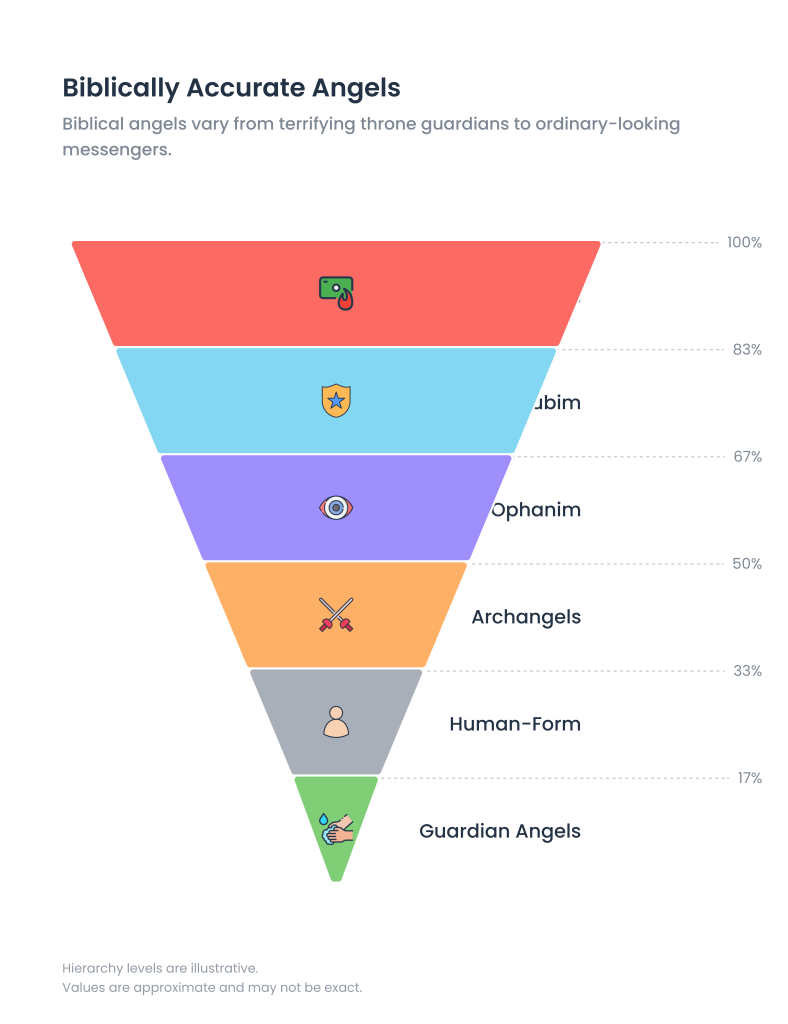
- Biblically accurate angels vary greatly in form, ranging from human-like messengers to majestic throne guardians like cherubim, seraphim, and ophanim, reflecting diverse roles rather than a single image.
- The primary biblical descriptions of angels emphasize their roles as messengers and servants of God, often inspiring fear due to their proximity to divine glory, rather than the sentimental figures common in Western art.
- Cherubim and seraphim are powerful, symbolic angelic beings with multiple wings and faces representing divine attributes like intelligence, strength, and worship, highlighting heaven’s ordered and intense holiness.
- The classic angel hierarchy with nine orders is a theological synthesis based on Scripture but not a direct biblical inventory, helping to organize the complex angelic world into triads with distinct functions.
- Most angels encountered by people in the Bible appear as ordinary men, showing that angelic beings are not always visually spectacular but can be subtle and unsettling as part of their divine mission.
- Scripture supports the existence of guardian angels who protect and serve humans as ministering spirits, but their role is to serve God first, not to replace personal responsibility or faith practices.

What Are Biblically Accurate Angels? Etymology and Definition
Biblically accurate angels means angelic beings as Scripture actually describes them, not as later art usually depictedthem.
The basic hebrew word is mal’akh, and the basic greek word is angelos. Both mean messengers. Translation: “angel” is often a job description before it is a body type. That matters a lot.
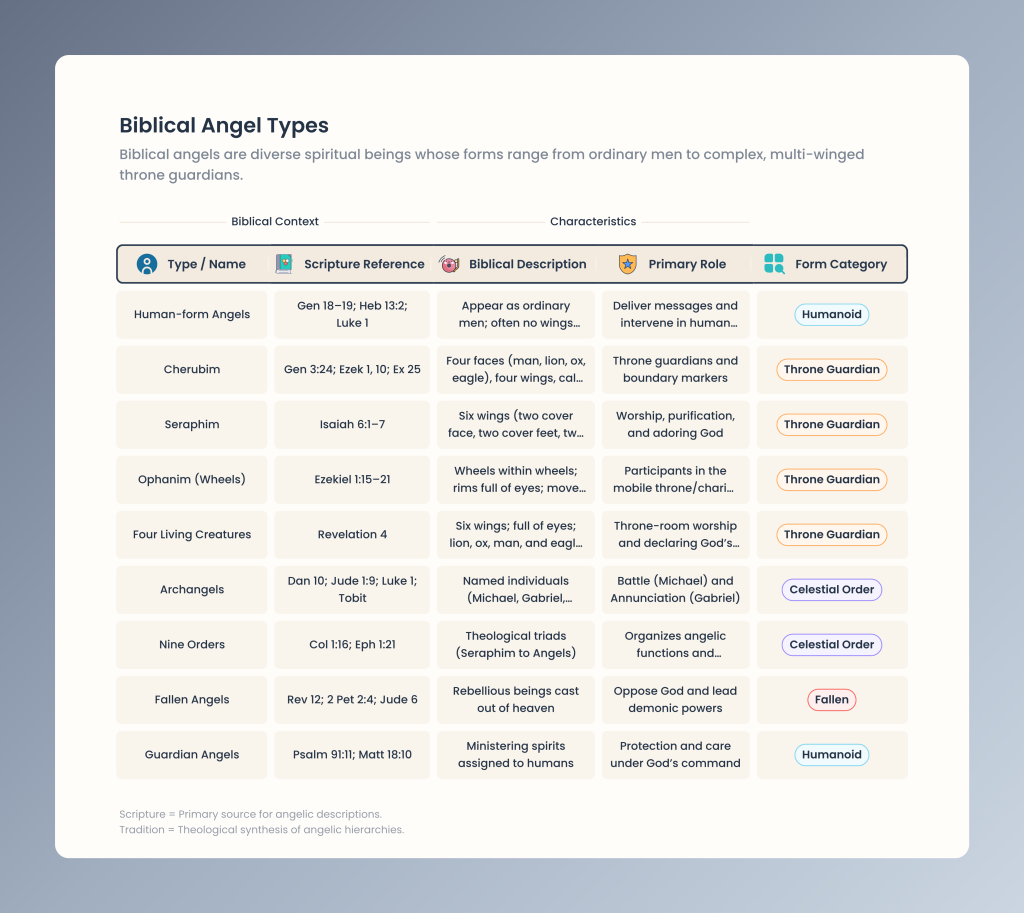
In the old testament and new testament, some god’s messengers look like human beings. Others are wild throne-room creatures: cherubim, seraphim, and the wheel-like beings often called ophanim. So when people ask about accurate angels, they’re usually asking about the most visually shocking passages, but most angels in Scripture are not described as giant eye-covered monsters.
Here’s the distinction I wish I’d known earlier. “Angel” in the bible can refer broadly to heavenly beings, but not every angelic being is described the same way. A messenger sent to Mary does not look like the living creatures in Ezekiel. A throne guardian is not the same thing as an archangel in battle.
Translation:
Biblically accurate angels are the angels Scripture presents in their different roles and forms, from ordinary-looking messengers to throne guardians full of symbolic glory.
In Plain English:
Don’t imagine one universal angel template. The text gives you an angelic world, not one stock image.
Here’s what this means for your faith:
If god made a rich variety of angelic beings, then heaven is not sentimental. It is ordered, intelligent, and intensely holy.
Tradition Check: The Church teaches that angels are pure spiritual creatures with intelligence and will (CCC 328–330). Art can help devotion, but art is not the norming source. Scripture is.

“Be Not Afraid”: Why Biblical Angels Terrified Everyone Who Saw Them
The line shows up for a reason: people were afraid.
When a messenger from heaven appears, the response is rarely casual. In Luke 1:12, Zechariah is troubled. In Luke 1:29–30, Mary is disturbed by Gabriel’s greeting. In Matthew 28:3–4, the angel at the tomb shines like lightning, and the guards collapse. A heavenly vision in Scripture is not a greeting card scene.
Part of that fear comes from appearance. Part comes from proximity to divine glory. Angels are ministering spirits sent by God, but they arrive carrying the weight of the lord’s presence. Hebrews 1:14 says they are sent to serve those who will inherit salvation. That sounds gentle. The experience of meeting one often isn’t.
I felt a little of this, oddly enough, standing in the dark of San Clemente in Rome during Vespers as chant echoed off the stone. Not fear exactly. More the sense that the unseen world is denser than our habits allow. And the biblical writers lived with that density.
Read It Yourself
“Are they not all ministering spirits sent forth to minister for them who shall be heirs of salvation?”, Hebrews 1:14
So why “be not afraid”? Because angelic encounters expose scale. You meet something not domestic, not manageable, not yours to control. Holy things do that.

Cherubim: The Four-Faced Guardians of God’s Throne
Cherubim are where the meme energy usually gets its fuel, and honestly, fair enough.
In Ezekiel 1 and 10, the prophet describes living creatures associated with the divine throne. Each has four faces, a human, lion, ox, and eagle, and four wings. Ezekiel also describes their legs as straight, their feet like a calf’s hoof, gleaming like burnished bronze. Later tradition identifies these creatures as cherubim explicitly in Ezekiel 10:20.
Their faces likely communicate created fullness and ordered power: human beings for intelligence, lion for wild majesty, ox for strength, eagle for swiftness. Hmm… actually, now that I think about it, some interpreters argue the ox face should be read in relation to temple sacrifice more than brute power, and that’s worth keeping in view.
The wings matter too. Ezekiel describes one pair stretched upward and another covering their bodies. So yes: two wingsactive, another one pair covering. The imagery is symbolic, liturgical, royal.
And cherubim appear earlier than Ezekiel. In Genesis 3:24, God places them east of Eden with a flaming sword to guard the way to the tree of life. In Exodus 25:18–20, two golden cherubim overshadow the Ark with wings extended. That means the sanctuary furniture itself was teaching Israel something about heaven.
If you want a deeper treatment, read our cherubim guide.
What I Wish I’d Known: I used to think cherubim were basically decorative angels. They’re not. They are throne guardians, boundary markers between earth and divine presence. Serious things.
Seraphim: The Burning Ones Who Worship God
If cherubim guard, seraphim burn and sing.
In Isaiah 6:1–7, the prophet Isaiah sees the Lord enthroned. Above him stand the seraphim, each with six wings: with two wings he covers his face, with two wings he covers his feet, and with two wings he flies. That exact number matters because the text repeats it carefully. These are not generic winged figures.
The likely hebrew term behind seraph is tied to burning. So the name suggests fiery or burning ones. They cry out, “Holy, holy, holy is the Lord of hosts: the whole earth is full of his glory” (Isaiah 6:3). Then one seraph takes burning coals from the altar and touches Isaiah’s lips.
That scene is both terrifying and cleansing.
Translation:
Seraphim are heavenly attendants whose worship reveals God’s holiness and whose fire purifies.
In Plain English:
They don’t exist to look pretty. They exist to adore god and prepare a sinner to hear his word.
Here’s what this means for your faith:
Real worship is not casual. It wounds pride before it heals the person.
For a fuller study, see our seraphim article. And yes, the liturgical echo here matters: the Church’s Sanctus is not inventing poetry. It is borrowing heaven’s song.
Ophanim: The Wheels Within Wheels Covered with Eyes
Here we get to the genuinely strange stuff.
In Ezekiel 1:15–21, alongside the throne beings appear four wheels on the earth, each seeming like a wheel intersecting a wheel, what people call wheels within wheels. Their rims are full of eyes all around. The movement is direct and uncanny. They do not turn as they go, because they move in perfect harmony with the living creatures. Ezekiel says, “the spirit of the living creatures was in the wheels.”
Some readers call these thrones: others use the later term ophanim. Are they independent angelic beings, symbolic throne-technology, or a visionary fusion of both? The text suggests more than machinery. It treats them as living participants in the mobile throne, god’s chariot moving across creation.
I remember discussing this in Jerusalem over bad station coffee with a Dominican archaeologist who shrugged and said, “Ezekiel is trying to describe the indescribable.” That felt right.
Not because the vision is vague. Because it is overloaded.
The eyes suggest total perception. The wheels suggest sovereign mobility. Israel’s God is not trapped in one shrine. He rules heaven and earth.
For more, read the ophanim explainer.
The Four Living Creatures: Revelation’s Heavenly Beings
Revelation 4 gives John a throne-room scene that echoes Ezekiel and Isaiah at once.
Around the throne are four living creatures, full of eyes in front and behind. One is like a lion, one like an ox, one has a face like a man, and one is like a flying eagle. Each has six wings. So unlike Ezekiel’s single being with four faces, Revelation presents four distinct throne beings, but the symbolism overlaps heavily.
Day and night they never cease to say, “Holy, holy, holy, Lord God Almighty” (Revelation 4:8). That links them to the seraphim of Isaiah even while their imagery recalls cherubim.
This is why simplistic charts can mislead. Biblical angelology is not flat. Images overlap because the bible verses are presenting heavenly worship, not giving you a zoology manual.
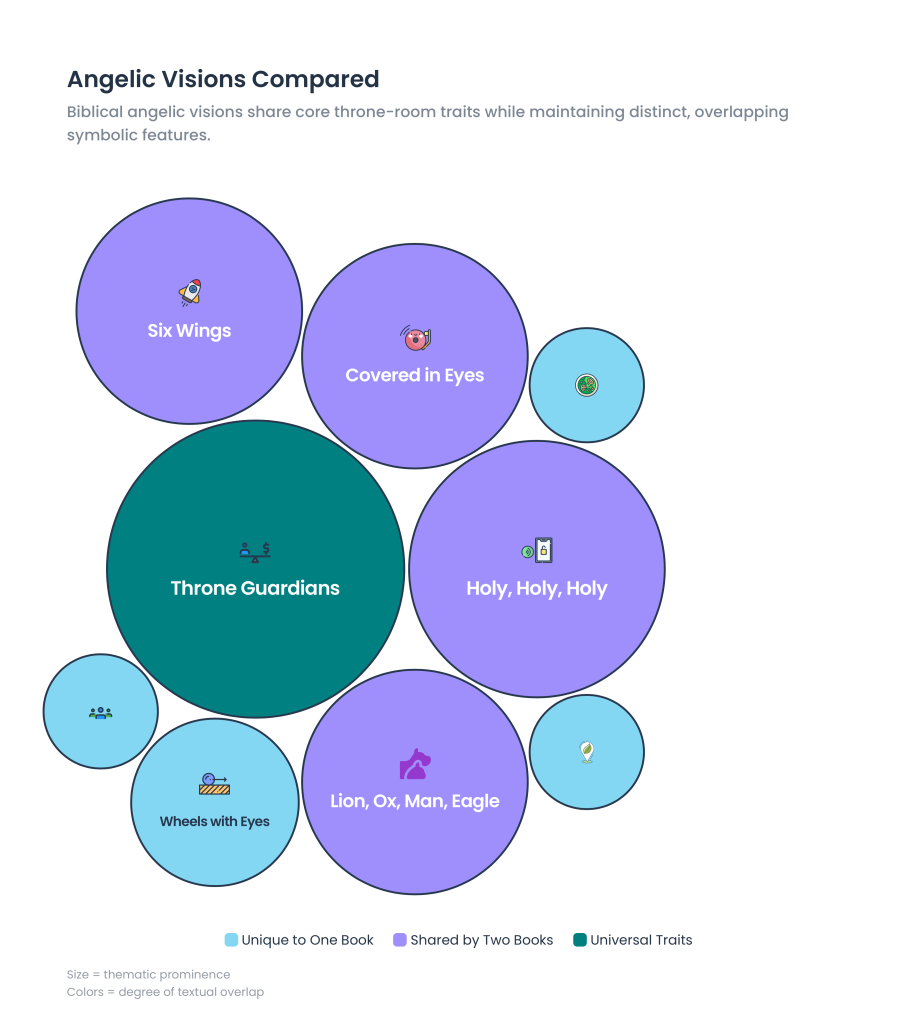
But the point is clear enough: heaven is alive with intelligent worship. These are not decorative background figures in white clouds and flowing white robes. They are liturgical, royal, awake. Entirely turned toward God.
Archangels: Michael, Gabriel, and the Named Angels of Scripture
The named angels in the Bible are fewer than many people assume.
In the Protestant canon, the only named angels are Michael and Gabriel. Michael appears in Daniel 10:13 and 12:1 as a great prince, in Jude 1:9 as archangel, and in Revelation 12:7 leading war against satan and his forces. Gabriel appears in Daniel 8:16 and 9:21, then in Luke 1 announcing John the Baptist and Jesus. Michael fights. Gabriel announces.
In Catholic and Orthodox Scripture, Raphael appears in Tobit as well. That matters because Christian angel teaching has never been built from the Protestant canon alone.
Protestant Perspective
A Protestant reader may object that deuterocanonical material shouldn’t shape doctrine. Fair enough, that dispute is really about canon, not angels. But even within the narrower canon, Michael and Gabriel already show distinct angelic missions.
Tradition Check
The Church does not encourage speculation about secret angel names or private hierarchies detached from revelation. Basta. Stay near the text.
For more, see archangels, Archangel Michael, and Gabriel.
Human-Form Angels: The Messengers You Wouldn’t Recognize
Here’s the surprise most meme pages miss: most angels in Scripture look like men.
Genesis 18–19 presents visitors to Abraham and then two angels arriving in Sodom. Hebrews 13:2 later says some have entertained angels unaware. That only works if angels can appear ordinary. In Daniel 10:5–6, the figure is dazzling, yes, but still described in recognizably human terms. In Luke 1, Gabriel speaks to Mary not as a cosmic beast but as a comprehensible messenger.
So when you ask what biblical angels look like, the answer is not one thing.
Sometimes they are throne guardians with eyes and wings. Sometimes they are human-form angels who could pass, at least initially, among humans. That’s why “angel” is more office than species label.
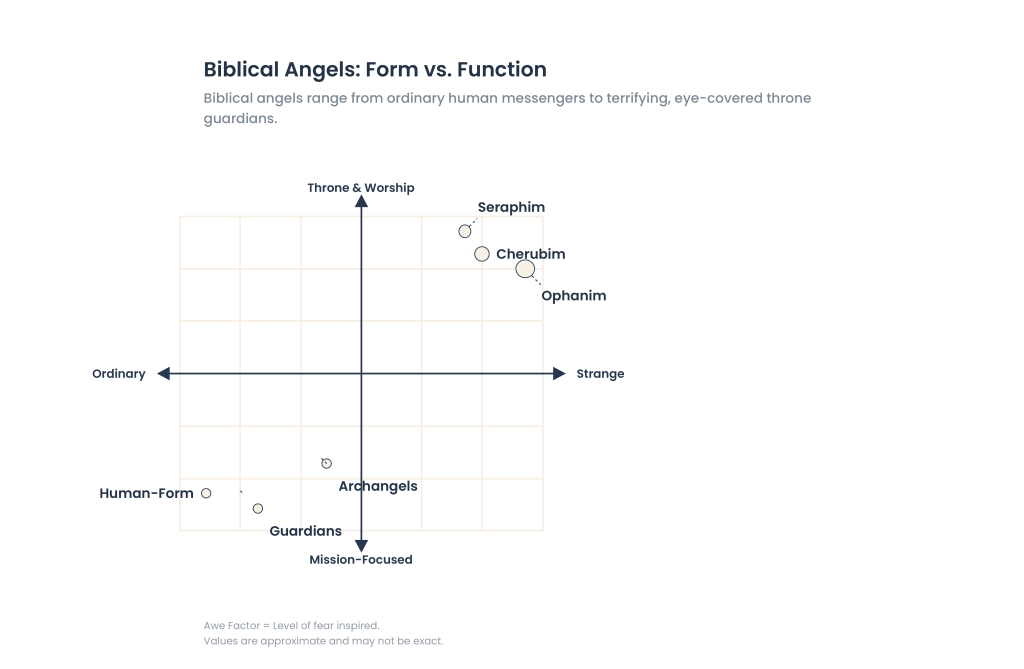
Look, this matters because internet theology often acts like every angel in Scripture has entire bodies covered in eyes. No. Some do not even have visible wings in the text. Some simply stand, speak, warn, and leave.
And that quiet form can be more unsettling than spectacle.
The Angel Hierarchy: Nine Orders from Seraphim to Messengers
The classic angel hierarchy of nine orders is not listed in one neat biblical paragraph. It comes from theological synthesis, especially Pseudo Dionysius in De Coelesti Hierarchia.

He arranged the celestial hierarchy in three triads: seraphim, cherubim, and thrones: then dominions, virtues, and powers: then principalities, archangel, and angels. The scheme draws on texts like Colossians 1:16 and Ephesians 1:21, then develops them into a structured account of heavenly order.
Translation:
The angel hierarchy is a theological map, not a verse-by-verse inventory.
In Plain English:
Scripture gives categories: later Christian thinkers organized them.
Catholic tradition has found this ordering fruitful, but it is not the same level as dogma. Important: The Catholic Church distinguishes between what Scripture clearly reveals and what later theology systematizes. So yes, the nine orders are venerable. No, you should not treat every medieval chart like a divinely dictated spreadsheet.
For a full breakdown, see our angel hierarchy guide.
Fallen Angels: When Heavenly Beings Rebelled
Scripture also speaks of fallen angels, heavenly beings who turned against God.
Revelation 12 presents satan cast down in connection with a war in heaven. 2 Peter 2:4 and Jude 6 refer to sinful angels held for judgment. Christian tradition reads this as an angelic rebellion, though the Bible does not narrate every detail people assume from later stories.
What about demons? Catholic theology typically treats demons as fallen angels. Some older interpretive traditions distinguished them differently, often under the influence of texts like 1 Enoch, but mainstream Christian doctrine identifies demonic powers with rebellious angelic beings.
Ezekiel 28 is sometimes connected typologically to satan as an anointed cherub, though in its literal historical context it addresses the king of Tyre. Read both levels carefully. The text is doing more than one thing at once.
Real Talk: Christian art often makes evil look more visually dramatic than holiness. Scripture often does the opposite. The truly frightening beings are the ones still near God.
How Western Art Got Angels Wrong: From Scripture to Renaissance Putti
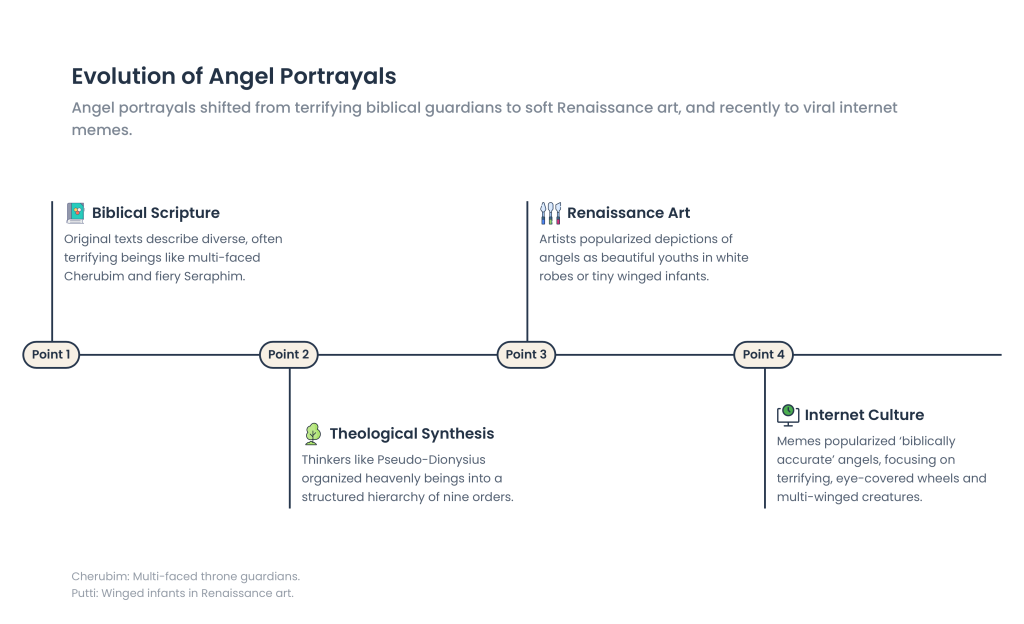
Western art did not invent angels, but it absolutely trained your imagination.
By the Renaissance, artists often depicted angels as beautiful youths in white robes, or as tiny winged infants, putti borrowed more from Greco-Roman visual culture than from Ezekiel. Halos became common. Soft features became standard. Renaissance cherubs ended up looking nothing like biblical cherubim.
And to be fair, sacred art is doing theology, not photography. An icon or fresco may emphasize purity, beauty, or nearness to heaven rather than literal form. My Orthodox grandmother used to kiss an icon of Michael before bed: she was not confusing iconography with anatomy. She understood that images teach by sign.
But confusion happens when artistic convention replaces the text. Then people assume all angels wear flowing white robes, all have one tidy pair of wings, and no one remembers the eye-covered wheels or the six-winged singers.
That was wrong. Deeply wrong.
So yes, art can serve devotion. But if you want biblically accurate angels, read Isaiah, Ezekiel, Daniel, Luke, Matthew, and Revelation before you read the museum wall label.
Guardian Angels: What Does the Bible Actually Say?
Guardian angels are one of those doctrines people either sentimentalize or dismiss too quickly.
The biblical case is real, though not always in the exaggerated form people imagine. Psalm 91:11 says God will command his angels concerning you. Matthew 18:10 speaks of the angels of “these little ones” always seeing the Father’s face. Acts 12:15 may reflect a Jewish-Christian assumption about personal angelic representation or protection.
Catholic tradition teaches that God gives guardian angels to care for human beings. Thomas Aquinas defended it: the Church’s liturgical calendar reflects it. The doctrine fits the broader biblical picture of angels as ministering spiritsserving those who inherit salvation.
The Sources Say
| Topic | What Scripture Shows | What Tradition Says |
|---|---|---|
| Protection | Psalm 91:11–12 | Angels guard by God’s command |
| Care for children | Matthew 18:10 | Personal angelic care is fitting |
| Deliverance | Acts 12 | Angels intervene in real history |
But guardian angels are not “only angels” assigned as cosmic life coaches. They serve God first. They do not replace prayer, prudence, or the Church. I once heard a monk on Patmos say, while feeding a cat that clearly ignored him, “Your angel is not your employee.” Exactly.
For further reading, stay close to Scripture first, then read the Fathers and the Catechism.
Frequently Asked Questions About Biblically Accurate Angels
What does ‘biblically accurate angels’ mean?
Biblically accurate angels are divine messengers as described in Scripture, featuring various forms like multi-faced cherubim, fiery seraphim, and eye-covered ophanim, distinct from popular artistic depictions of angels as gentle humans with wings.
Why do biblical angels often cause fear rather than comfort?
Biblical angels frequently appear in terrifying forms with radiant glory or strange features, symbolizing God’s holiness and power. Their presence reveals divine majesty, which naturally causes fear or awe in those who encounter them, as seen in multiple scripture passages.
What are cherubim according to the Bible?
Cherubim are throne guardians described as having four faces (human, lion, ox, eagle), four wings, and feet like a calf’s hoof, associated with protecting God’s presence and symbolizing intelligence, majesty, strength, and swiftness in Ezekiel’s vision.
How are seraphim depicted in Scripture and what is their role?
Seraphim are six-winged fiery beings who worship around God’s throne, declaring “Holy, holy, holy.” Their burning presence symbolizes purification and reverence, highlighting God’s holiness as described in Isaiah 6.
Who are the named archangels in the Bible and what are their roles?
Michael and Gabriel are two named archangels in the Bible. Michael is a warrior leading heavenly battles, while Gabriel serves as a messenger announcing key events like the births of John the Baptist and Jesus. Catholic tradition also recognizes Raphael from Tobit.
Why do angels sometimes appear as ordinary men in the Bible?
Many biblical angels appear in human form to interact with people discreetly or deliver messages, allowing them to blend in without causing alarm, such as the visitors at Abraham’s tent or the angel at Jesus’ tomb.