The Ark of the Covenant was the gold-covered chest in which Moses placed the two stone tablets inscribed with the Ten Commandments. It was small enough to carry on poles. English translations of Genesis also use the word ark for Noah’s vessel, which carried his family and the animals through the flood. The Bible traces the chest to the Temple in Jerusalem, but its present location is unknown.
Exodus 25:10–16 · Deuteronomy 10:1–5 · Genesis 6:14–21 · 1 Kings 8:6–9What did the Ark look like, and how big was it?
Exodus 25 gives God’s instructions to Moses. Exodus 37 names Bezalel as the craftsman who made the chest from acacia wood, covered it inside and out with pure gold, and added gold molding around it. Four gold rings, two on each side, held the gold-covered acacia poles used to carry it. The directions specify that the poles should stay in the rings.
Exodus 25:10–15 · Exodus 37:1–5The Ark measured 2½ cubits long, 1½ cubits wide and 1½ cubits high. Using the World English Bible’s estimate of 18 inches per cubit, that works out to 45 × 27 × 27 inches, or about 114 × 69 × 69 centimetres. Its width and height were equal whichever cubit length is used.
Exodus 25:10 and its note on the cubitThe pure-gold cover, often called the mercy seat, matched the length and width of the chest. At either end was a hammered gold cherub, made in one piece with the cover. The two cherubim faced one another, looking down toward the cover with their wings spread above it.
Exodus 25:17–22, WEB · Exodus 25:17–22, NABREWhat was inside the Ark?
The stone tablets are the one item both Kings and Hebrews place inside the Ark. For the manna and Aaron’s staff, the wording changes with the passage.
| Passage | Object and placement |
|---|---|
| Deuteronomy 10:1–5 | Moses puts the two replacement tablets in the Ark after returning from the mountain. |
| Exodus 16:32–34 | Aaron keeps a jar of manna before the testimony so future generations can see the food given in the wilderness. |
| Numbers 17:8–10 | God tells Moses to put Aaron’s staff, which had budded and borne almonds, back before the covenant as a sign to those who rebelled. |
| 1 Kings 8:6–9 | At the dedication of Solomon’s Temple, the Ark held only the two stone tablets. |
| Hebrews 9:3–5 | In its description of the wilderness sanctuary, Hebrews places three things inside the Ark. They are a gold jar holding manna, Aaron’s staff that budded, and the covenant tablets. |
In Exodus and Numbers, “before” tells readers where the memorial objects were presented or kept without saying they were put inside the chest. Neither Kings nor Hebrews tells us whether anyone moved the jar or the staff between the two settings.
Why was the Ark kept in the Holy of Holies?
Inside the tabernacle, a curtain separated the Holy of Holies from the rest of the tent. The Ark stood beyond that curtain. In Exodus, God promises to meet Moses there, and Numbers describes Moses hearing a voice from above the cover, between the two cherubim.
Exodus 26:31–34 · Exodus 25:21–22 · Numbers 7:89On the annual Day of Atonement, Aaron was to sprinkle sacrificial blood on and in front of the cover to make atonement for the sanctuary. Hebrews later draws on that ritual to explain Christ’s work as high priest, describing his entry into the holy place through his own blood.
Leviticus 16:14–16, 29–34 · Hebrews 9:11–14How did the Ark reach Solomon’s Temple?
At the Jordan River, Joshua says the priests carrying the Ark stood on dry ground in the riverbed until the people crossed. At Jericho, seven priests sounding trumpets marched ahead of the Ark as the Israelites circled the city.
Joshua 3:13–17 · Joshua 6:6–9, 15–20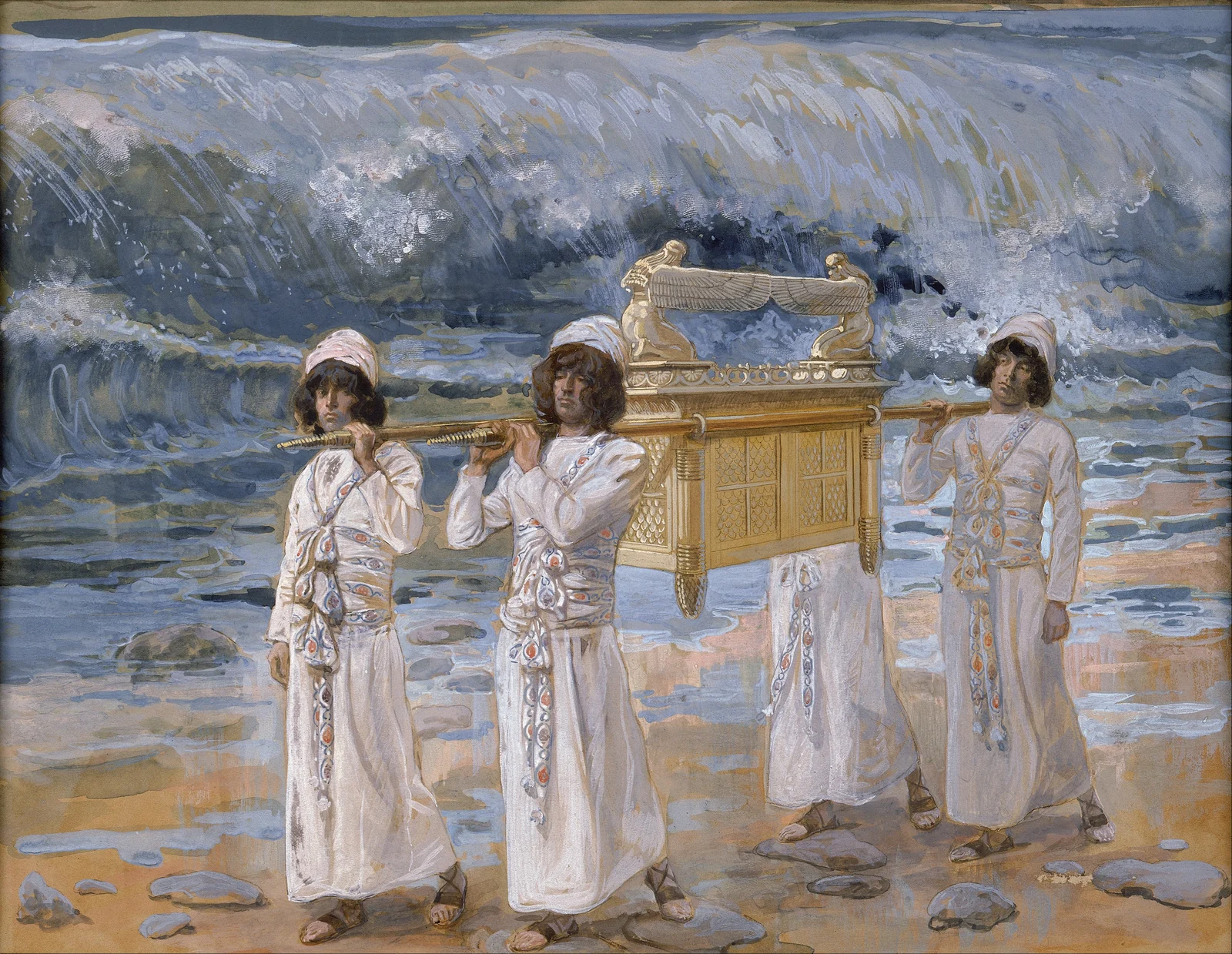
First Samuel tells of a battle in which Israel’s elders sent for the Ark from Shiloh, hoping it would save them from the Philistines. Israel lost the battle and the Philistines captured the Ark. The Philistines eventually sent it back on a cart that reached Beth Shemesh. From there the people of Kiriath Jearim brought it to the house of Abinadab.
1 Samuel 4:3–11 · 1 Samuel 6:7–16, 21 · 1 Samuel 7:1–2David’s first attempt to move the Ark ended when Uzzah reached out to steady it and died. The Ark stayed three months with Obed-Edom before David brought it to Jerusalem and set it in a tent. It was under David’s son Solomon that the priests carried the Ark into the Temple and placed it in the innermost room.
2 Samuel 6:3–17 · 1 Kings 8:1–11Where is the Ark last mentioned in the Bible?
One of the last earthly references in the Hebrew Bible comes during King Josiah’s preparations for Passover. In 2 Chronicles 35:3 he tells the Levites to put the holy Ark in the Temple Solomon built. When 2 Kings recounts the Babylonian destruction of the Temple, it lists bronze pillars, basins and other objects taken away. The Ark is absent from that list, leaving open whether it was removed beforehand, taken or destroyed.
2 Chronicles 35:1–6 · 2 Kings 25:8–17Jeremiah 3:16 looks ahead to a time when people will no longer remember or miss the Ark. The last New Testament reference comes in Revelation 11:19, where John sees the Ark in God’s temple in heaven. Neither passage records a journey of the earthly chest after Josiah.
Jeremiah 3:16–17 · Revelation 11:19Where do the traditions about the lost Ark come from?
Mount Nebo. A letter preserved in 2 Maccabees, a book included in Catholic Bibles, recounts that Jeremiah hid the tent, the Ark and the incense altar in a cave. The letter identifies the mountain as the one from which Moses saw the promised land. Deuteronomy calls it Mount Nebo. In the letter, Jeremiah says the hiding place will remain unknown until God gathers his people again.
2 Maccabees 2:1–8 · Deuteronomy 34:1Jerusalem. The Mishnah records that certain families made an extra bow opposite the Temple’s wood store. They had inherited a tradition that the Ark was hidden there.
Mishnah Shekalim 6:1Aksum, Ethiopia. In 1 Kings 10, the queen of Sheba visits Solomon and returns home. The medieval Ethiopian Kebra Nagast tells a further story in which the Ark travels to Ethiopia with their son, known as Menelik, and his companions. Ethiopian Orthodox tradition places the Ark at Aksum. In an interview with Smithsonian, Patriarch Abuna Paulos explained that only the guardian could see it. The object’s identity has not been independently verified.
1 Kings 10:1–13 · Kebra Nagast, chapters 48 and 53–55 · Smithsonian’s interview in EthiopiaThe 1981 film Raiders of the Lost Ark gives the search a fictional setting in 1936, with Indiana Jones racing Nazi rivals to find the chest. No publicly verified discovery establishes where the ancient chest is today.
Lucasfilm on Raiders of the Lost Ark