Ophanim in the Bible: Ezekiel’s Wheels and Later Interpretations
Ophanim means “wheels,” and Ezekiel’s vision describes wheels beside the living creatures, with the appearance of a wheel within a wheel and eyes covering their high rims. The word’s meaning, the wheels in the prophetic scene and later descriptions of heavenly classes are related subjects, but they are not the same claim. Chagigah 12b provides one later example of ofanim named alongside other heavenly beings; it does not make every wheel, cherub and Christian Throne order interchangeable.
Sources: Ezekiel 1:15–16; 1:16–18 (NABRE) · Chagigah 12b:14, Sefaria translation · Brown–Driver–Briggs, Hebrew 212Ezekiel’s vision in Ezekiel 1:15–21 serves as the primary source for the wheels’ appearance and their relation to the creatures. Start with the features in Ezekiel 1, then compare chapter 10 and the later uses of the term.
Sources: Ezekiel 1:15–16; 1:16–18 (NABRE)What does ophanim mean?
Ophan means “wheel”; ophanim is the plural, “wheels.” The original Brown–Driver–Briggs entry distinguishes ordinary wheel uses from the wheels in Ezekiel’s vision. Ofanim is another English transliteration, used in the Sefaria translation of the later Chagigah passage discussed below.
Sources: Chagigah 12b:14, Sefaria translation · Brown–Driver–Briggs, Hebrew 212An ordinary word for wheels does not turn every use of that word into a reference to a heavenly class. For Ezekiel, the surrounding scene establishes which wheels are being described; for a later theological text, its own wording establishes how the term is used. The broader guide to biblically accurate angels places this subject alongside other passage-specific appearances without making wheels the anatomy of every angel.
Sources: Chagigah 12b:14, Sefaria translation · Brown–Driver–Briggs, Hebrew 212What Ezekiel 1 describes beside the living creatures
Ezekiel 1 places one wheel on the ground beside each of four living creatures. The account then describes the wheels’ appearance as a wheel within a wheel and their high rims as filled with eyes. These details identify location, appearance and a particular part of the wheels, rather than a complete mechanical design.
Sources: Ezekiel 1:5–12; 1:15–16; 1:16–18 (NABRE)| Feature | Passage | What the wording establishes |
|---|---|---|
| One beside each creature | Ezekiel 1:5, 15–16 | Four living creatures, with a wheel beside each |
| Wheel within a wheel | Ezekiel 1:16–17 | A description of appearance and movement, not a measured intersection angle |
| Eyes on the high rims | Ezekiel 1:18 | The rims are filled with eyes; an exact eye total is not supplied |
The four-wheel arrangement and the wheel-within-wheel description answer different questions: the first concerns how many stand beside the creatures, while the second concerns a wheel’s appearance. Neither a measured diameter nor a fixed ninety-degree intersection follows from those phrases. The creatures have their own description, with four faces and four wings each; the guide to cherubim in their different passages develops that subject separately.
Sources: Ezekiel 1:5–12; 1:15–16; 1:16–18 (NABRE)How the wheels and creatures move together
The wheels and living creatures move, stand and rise together in Ezekiel’s account, directed in the scene by the spirit. Ezekiel 1:19–21 describes the wheels moving when the creatures move and rising when the creatures rise; Ezekiel 10:16–17 repeats their coordinated movement and standing. The passage gives that relationship without explaining a propulsion mechanism or a system of physical engineering.
Sources: Ezekiel 1:19–21 (NABRE) · Ezekiel 10:16–17 (NABRE)Above the creatures is an expanse, and above it Ezekiel describes a throne-like form. The language of vision and likeness matters: the account establishes an above-and-below relationship, not a measured scale drawing of a vehicle.
Sources: Ezekiel 1:22–28 (NABRE) · Ezekiel 10:1 (NABRE)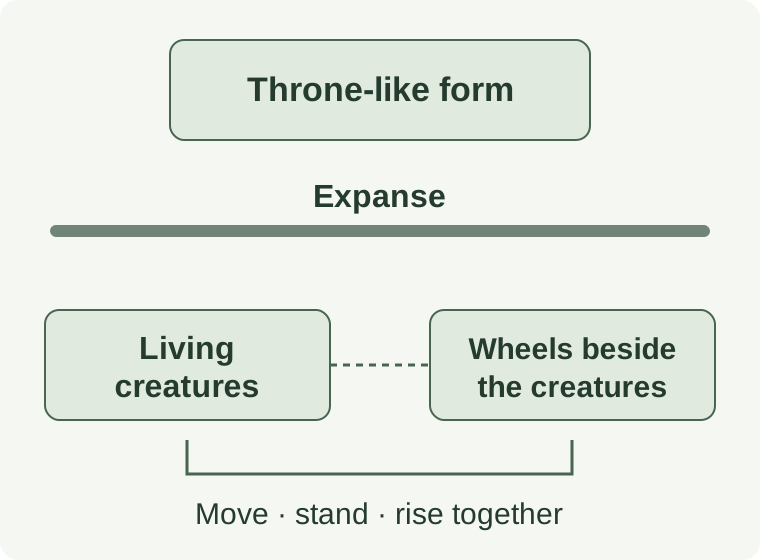
The account places a throne-like form above the expanse over the creatures and describes wheels beside them, moving with them.
The schematic separates the groups and their relationships; its boxes do not show the total number or complete appearance of the beings. Its shared movement line summarizes moving, standing and rising together, rather than showing a mechanical connection. For the wider setting, see the throne of God in biblical visions.
Sources: Ezekiel 1:19–21 (NABRE) · Ezekiel 10:16–17 (NABRE)What Ezekiel 10 adds: cherubim, wheels and eyes
Ezekiel 10 identifies the living creatures as cherubim and again places four wheels beside them, one beside each cherub. Its eye description is broader than the reference to rims in chapter 1: Ezekiel 10:12 associates eyes with bodies, backs, hands, wings and wheels. The property belongs to the subjects and parts named in that account, not to an undifferentiated floating ball of eyes.
Sources: Ezekiel 10:9–10, 20–22; 10:12 (NABRE)| Account | Location named for eyes | Relationship retained |
|---|---|---|
| Ezekiel 1:18 | The wheels’ high rims | The chapter-one rim description is specific to that part |
| Ezekiel 10:12, 16–17 | Bodies, backs, hands, wings and wheels | The wheels still move and rise with the creatures |
Chapter 10’s identification of the creatures does not erase the distinction between a creature, a wing, a wheel and a rim. It also does not justify silently replacing one chapter’s descriptive wording with the other’s. The fuller treatment of cherubim in their different passages compares the creature accounts beyond this wheel-focused question.
Sources: Ezekiel 10:9–10, 20–22; 10:12 (NABRE)From Ezekiel’s wheels to ofanim in later Jewish literature
A named example of later ofanim usage appears in the Babylonian Talmud, Chagigah 12b:14. In Sefaria’s English translation of the Aravot passage, ofanim are listed with seraphim, holy creatures and ministering angels, alongside the Throne of Glory. This is a later text using heavenly terms in its own description, rather than another verse from Ezekiel’s vision.
Sources: Chagigah 12b:14, Sefaria translation · Brown–Driver–Briggs, Hebrew 212That passage provides evidence for this particular reception of the term; it does not establish the first occasion on which wheels were classified among heavenly beings. Nor does one enumeration speak for every Jewish tradition or prove a single, uninterrupted system behind every later account. The distinction lets the prophetic description and the later religious interpretation remain readable on their own terms.
Sources: Chagigah 12b:14, Sefaria translationAre Ophanim and Thrones the same?
The supplied sources do not establish Ophanim and Thrones as interchangeable labels: Ezekiel describes wheels beside creatures, Colossians names thrones, and Pseudo-Dionysius discusses a later celestial order. A shared connection with a divine throne is not, by itself, an explicit identification of the wheels with that order.
Sources: Colossians 1:15–17 (NABRE) · Pseudo-Dionysius, Celestial Hierarchy VI · Ezekiel 1:15–16 (NABRE) · Ezekiel 10:9–10, 20–22 (NABRE)| Label | Source | What it supplies | What it does not establish |
|---|---|---|---|
| Ophan / ophanim; Ezekiel’s wheels | BDB Hebrew 212; Ezekiel 1:15–18 and 10:9–10, 20–22 | Wheel / wheels; wheels beside the creatures identified as cherubim | A universal identity with the Christian Thrones order |
| Thrones | Colossians 1:15–17 | A term among things created through and for Christ | A wheel anatomy or a complete nine-order chart |
| Thrones as a celestial order | Pseudo-Dionysius, Celestial Hierarchy VI–VII | A first hierarchy with seraphim and cherubim; elevation, stability and receptivity to divine participation | An explicit equation in these chapters with Ezekiel’s wheels |
Chapter VI arranges nine interpretative names in three threefold orders, placing thrones with seraphim and cherubim in the first hierarchy. A later author may identify the wheels with Thrones, but that identification needs its own named source and passage. The biblical vocabulary and the later hierarchy belong to different texts and interpretive contexts. For more on the Christian order, see Thrones in Christian angelic hierarchy.
Sources: Colossians 1:15–17 (NABRE) · Pseudo-Dionysius, Celestial Hierarchy VI · Pseudo-Dionysius, Celestial Hierarchy VIIWhat can an image of the wheels legitimately show?
A clearly labelled relationship diagram can show wheels beside the creatures, a throne-like form above the expanse and the wheels moving with the creatures. Ezekiel 1’s eyes belong on the rims when that specific feature is depicted; a neutral group symbol need not be a complete portrait of every stated attribute. The schematic above therefore uses group labels for spatial and movement relationships rather than an invented body reconstruction.
Sources: Ezekiel 1:15–16; 1:16–18; 1:19–21; 1:22–28 (NABRE) · Ezekiel 10:16–17; 10:1 (NABRE)Its illustrative positions and colors are not measured facts about the vision, and its symbols do not provide a census of the beings. Likewise, a circle in such a schematic does not establish the wheels’ exact geometry or a total number of eyes. The adjacent text gives the same above, beside and move-with relationships so the image is not the only way to understand them.
Sources: