Jezebel in the Bible: Royal Manipulation, Religious Warfare, and Prophetic Judgment
Jezebel in the Bible: Royal Manipulation, Religious Warfare, and Prophetic Judgment
Key Takeaways
- Jezebel in the Bible was primarily condemned for promoting Baal worship over Yahweh worship in ancient Israel, not for sexual immorality as commonly misunderstood.
- As a Phoenician princess who married King Ahab, Jezebel maintained her religious identity and established Baal worship in Israel, representing a fundamental threat to Israel’s covenant relationship with Yahweh.
- Jezebel’s dramatic death in 2 Kings 9, where she was thrown from a window and her body eaten by dogs, fulfilled Elijah’s prophecy and served as divine retribution in the biblical narrative.
- The term ‘Jezebel spirit’ in modern charismatic Christianity combines the historical queen from 1 Kings with the symbolic Jezebel mentioned in Revelation 2:20, often applied as a gendered accusation against women in leadership.
- Modern misapplications of the ‘Jezebel’ label have transformed her from a powerful religious and political figure into a problematic stereotype used to control women in religious communities.
- Alternative scholarly interpretations view Jezebel as a complex historical figure whose negative portrayal served the theological purposes of biblical writers concerned with exclusive Yahweh worship.

Who Was Jezebel in the Bible and Why Does She Still Matter Today?
The biblical Jezebel emerges in 1 Kings as a Phoenician princess who married Ahab, king of Israel’s northern kingdom, a political alliance that brought religious warfare to ancient Israel’s doorstep. When Ahab told Jezebel about Elijah’s slaughter of Baal’s prophets, she swore vengeance against the prophet in explicit terms: “May the gods do to me and more also, if I do not make your life as the life of one of them by this time tomorrow” (1 Kings 19:2). This wasn’t merely personal revenge: it was theological combat between Baal worship and Yahweh worship, played out on the stage of royal politics.
Cultural, Religious, and Psychological Echoes of Jezebel’s Legacy
The Jezebel archetype has evolved far beyond its biblical origins. In Christian theology, especially in charismatic traditions, the term “Jezebel spirit” describes a manipulative, controlling spiritual influence that operates through sexual immorality and false religious authority. The woman Jezebel mentioned in Revelation 2:20, who teaches believers to “eat food sacrificed to idols and to commit sexual immorality,” reinforced this theological construct, creating a transhistorical archetype of feminine rebellion against divine authority.
Here’s what’s fascinating: the Hebrew text presents Jezebel not primarily as sexually immoral (contrary to modern assumptions), but as politically ruthless and religiously devoted to foreign gods. Her primary conflict with Yahweh worship centered around her unwavering support for Baal, the Phoenician nature god associated with fertility, storms, and agricultural abundance.
What This Article Will Explore About Jezebel in the Bible
I’ll examine the biblical narrative surrounding Jezebel from multiple angles, historical, theological, linguistic, and contemporary. We’ll explore who Jezebel was according to the biblical text, how manuscript traditions shaped her portrayal, what archaeological evidence reveals about her historical context, and how her image has been used (and misused) throughout religious history.
As scholar Janet Howe Gaines has observed in Biblical Archaeology Review, the portrayal of Jezebel reflects the biblical writers’ theological concerns more than objective historical reporting. The Hebrew Bible constructs her as the paradigmatic opponent of Yahweh worship, a theological necessity for a narrative centered on covenant faithfulness. Understanding this context helps us recognize how ancient religious conflicts shape our contemporary spiritual language, sometimes in problematic ways.
The Identity of Jezebel in the Bible
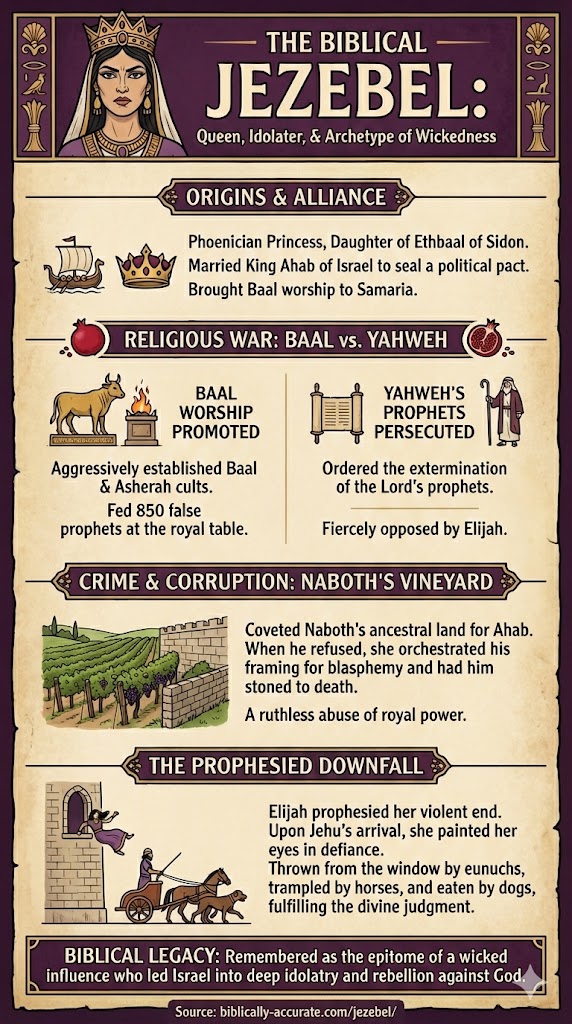
The biblical text introduces Jezebel with immediate theological concern: “Ahab son of Omri did more evil in the eyes of the LORD than any of those before him. He not only considered it trivial to commit the sins of Jeroboam son of Nebat, but he also married Jezebel daughter of Ethbaal king of the Sidonians, and began to serve Baal and worship him” (1 Kings 16:30-31). This framing immediately positions Jezebel not as a complex political figure, but as the embodiment of religious apostasy.
Jezebel’s Background: Daughter of a Phoenician King
The Hebrew text identifies Jezebel as bat-‘Et̲ba’al melek̲ Ṣidōnîm (בַת־אֶתְבַּעַל מֶלֶךְ צִידֹנִים), daughter of Ethbaal, king of the Sidonians. This isn’t merely genealogical information: it’s theological context. The name Ethbaal itself means “with Baal” or “Baal is with him”, a theophoric name that signaled religious allegiance to the Phoenician deity.
Extra-biblical sources, particularly the writings of Josephus who quotes the Phoenician historian Menander, identify her father as Ithobaal I, a priest of Astarte who seized the throne of Tyre. This would make Jezebel a Tyrian princess rather than Sidonian, though the biblical writers often used “Sidonian” as a general term for Phoenicians.
As a royal daughter from a Phoenician dynasty, Jezebel would have been raised in the worship of Baal and Asherah, with their elaborate temples, professional priestly class, and royal endorsement. She wasn’t simply bringing foreign religious ideas to Israel, she was bringing an entire religious-political system.
Marriage to King Ahab: Political Alliance or Spiritual Downfall?
When Jezebel married Ahab king of Israel, the union represented standard ancient Near Eastern diplomacy, political alliances sealed through royal marriages. The northern kingdom of Israel, separated from Jerusalem and the Davidic dynasty, needed commercial and military allies against regional threats, particularly the growing Aramean powers.
What makes this marriage unique is how the biblical writers frame it not as wise statecraft, but as covenant betrayal. Ahab’s decision to marry Jezebel resulted in his worship of Baal. The text states: “He set up an altar for Baal in the temple of Baal that he built in Samaria. Ahab also made an Asherah pole and did more to arouse the anger of the LORD, the God of Israel, than did all the kings of Israel before him” (1 Kings 16:32-33).
The Hebrew text employs specific theological language here, Ahab vayya’avōd (וַיַּעֲבֹד, “served”) Baal and vayyištaḥû(וַיִּשְׁתַּחוּ, “bowed down”) to him. These are covenant terms elsewhere used to describe proper worship of Yahweh, now directed toward a foreign deity. For the biblical writers, this marriage wasn’t merely diplomatic, it was apostasy.
Religious Conflict: Baal Worship vs. Yahweh Worship in 1 Kings
The clash between Baal worship and Yahweh worship forms the theological heart of Jezebel’s narrative. When the text states that Jezebel “killed the prophets of the LORD” (1 Kings 18:13), it portrays her as engaged in theological warfare. Baal, as a nature god associated with rain and fertility, represented a powerful theological alternative to Yahweh in an agricultural society dependent on seasonal rains.
The Hebrew Bible presents the ultimate showdown between these competing religious systems on Mount Carmel, where Elijah challenged the prophets of Baal to a theological contest, calling down fire from heaven. The text tells us there were 450 prophets of Baal and 400 prophets of Asherah “who eat at Jezebel’s table” (1 Kings 18:19).
This detail, eating at the queen’s table, isn’t incidental. It indicates royal patronage and official status. Jezebel wasn’t merely practicing private devotion: she was establishing an alternative state religion with institutional support. The Mount Carmel confrontation ends with Elijah’s victory and the slaughter of Baal’s prophets, leading to Jezebel’s infamous threat against the prophet Elijah.
What’s often missed in casual readings is that this religious conflict wasn’t simply theological, it was existential for both sides. For the Yahwistic prophets, Baal worship threatened Israel’s covenant identity and security. For Jezebel, raised in Phoenician royal religion, the attack on Baal’s prophets represented an assault on her cultural heritage, religious identity, and royal prerogative.
The Jezebel Spirit: Theology, Symbolism, and Modern Usage
The concept of a “Jezebel spirit” represents one of the most significant theological afterlives of the biblical queen. While not explicitly