In the Bible, heaven can mean the sky where birds fly or the dwelling of God, who hears Solomon’s prayer. In Revelation, John sees a throne surrounded by worshipers, then later watches a city descend from heaven after a new earth appears. The pearl gates, gold street and tree of life belong to that city, the New Jerusalem. Jesus offers his disciples a different kind of description when he promises that they will be with him in his Father’s house.
| Passage | What the reader is shown |
|---|---|
| Genesis 1:6–8, 20 | The sky stretches above the earth. Birds fly across it. |
| 1 Kings 8:27–30 | Solomon asks God to hear prayers from heaven, even as he says the highest heavens cannot contain God. |
| Revelation 4:1–11 | Through an open door in heaven, John sees a throne, four living creatures and twenty-four elders. |
| Revelation 21:1–4 | John sees a new heaven and a new earth. The holy city comes down from God, who will dwell among human beings. |
When does heaven mean the sky or God’s dwelling?
In Genesis, lights in the sky mark days and seasons, and birds fly across the same expanse. At the dedication of the Temple in Jerusalem, Solomon uses heaven to speak about God hearing people who pray. He asks God to listen and forgive from his heavenly dwelling, yet wonders how even the highest heavens could contain him, much less the house Solomon has built. Jesus draws heaven and earth together in the Lord’s Prayer when he teaches his followers to ask for God’s will to be done here as it is in heaven.
Genesis 1:6–8, 14–20 · 1 Kings 8:27–30 · Matthew 6:9–10What do Isaiah and John see around the throne?
When Isaiah sees the Lord enthroned, the hem of the Lord’s robe fills the Temple and smoke fills the building. The six-winged seraphim call to one another about God’s holiness and the glory that fills the earth. One brings a glowing coal from the altar to Isaiah’s lips before the prophet hears the call to go and speak.
Isaiah 6:1–8In Revelation 4, John sees a rainbow like an emerald around the throne and something like a glass sea before it. The four living creatures proclaim God’s holiness day and night. The twenty-four elders answer by falling down, laying their crowns before the throne and praising God as creator.
Revelation 4:1–11The Father’s house, paradise and the third heaven
In John 14, Jesus speaks about his departure to disciples who are troubled at the prospect of losing him. He describes many dwelling places in his Father’s house and says he will prepare a place for them and come for them. He wants them to be where he is, and that reunion is the promise he asks them to trust.
John 14:1–6Paul uses different language in 2 Corinthians 12, recounting in the third person how someone was caught up to the third heaven, which the account also calls paradise. Paul says that God knows whether this happened in the body or outside it, and that what the person heard could not be repeated. He gives no names for a first or second heaven and no route between them.
2 Corinthians 12:1–4Where are the pearly gates, the gold street and the tree of life?
An angel invites John to see the bride of the Lamb and shows him Jerusalem coming down from God. The city measures twelve thousand stadia in length, width and height, three equal dimensions in John’s vision. Its jasper wall has twelve gates named for Israel’s tribes, while the foundations carry the names of the Lamb’s twelve apostles. Each gate is a single pearl, and John compares the pure gold of the city’s street to transparent glass.
Revelation 21:9–21, including the measurement noteJohn sees no temple building in the city because God and the Lamb are its temple. The city has no need of sun or moon to light it because God’s glory gives it light and the Lamb is its lamp. A river flows from their throne, and the tree of life bears fruit each month, with leaves for the healing of the nations. God wipes away the people’s tears and death comes to an end, a promise that becomes personal again when John says that God’s servants will see his face.
Revelation 21:3–4, 22–25 · Revelation 22:1–5What do the Gospels and Paul say about life after death?
In Luke’s account of the crucifixion, one of the criminals beside Jesus asks to be remembered when Jesus comes into his kingdom. Jesus answers that the man will be with him in paradise that day. Paul voices a related hope in 2 Corinthians when he says he would prefer to leave the body and be at home with the Lord. When the Corinthians ask about the dead being raised, Paul starts with Christ’s resurrection and describes a bodily transformation at the last trumpet. What goes into the ground perishable, he says, is raised imperishable.
Luke 23:39–43 · 2 Corinthians 5:1–10 · 1 Corinthians 15:20–23, 35–44, 51–58How have Christian traditions understood heaven?
Augustine ends The City of God by imagining an eternal Sabbath in which rest leaves people free to see, love and praise God. The Catholic Catechism calls the direct sight of God the beatific vision. In its teaching on purgatory, some who die in God’s grace still need purification, even though their salvation is already assured.
Augustine, The City of God, book XXII, chapters 29–30 · Catholic Catechism, §§1023–1029 · Catholic Catechism, §§1030–1031The Westminster Confession, a Reformed Protestant confession, says the souls of the righteous behold God after death while awaiting the resurrection of their bodies. The Orthodox Church in America explains theosis as coming to share in divine life through Christ. These writers ask what it means for a human being to live with God, a question the pictures of gates and streets answer only in part.
Westminster Confession, chapter 32 · The Orthodox Faith on the Ascension and theosisWhere do the clouds, harps and Saint Peter at the gate come from?
The familiar scene of Peter checking arrivals at a pearly gate puts two passages together. Jesus gives Peter the keys of the kingdom in Matthew 16 and speaks of binding and loosing on earth and in heaven. In John’s city vision, twelve angels stand at the gates, which stay open during the day, and the city has no night. In Revelation 15, the people who have overcome the beast hold harps and sing beside what looks like a sea of glass.
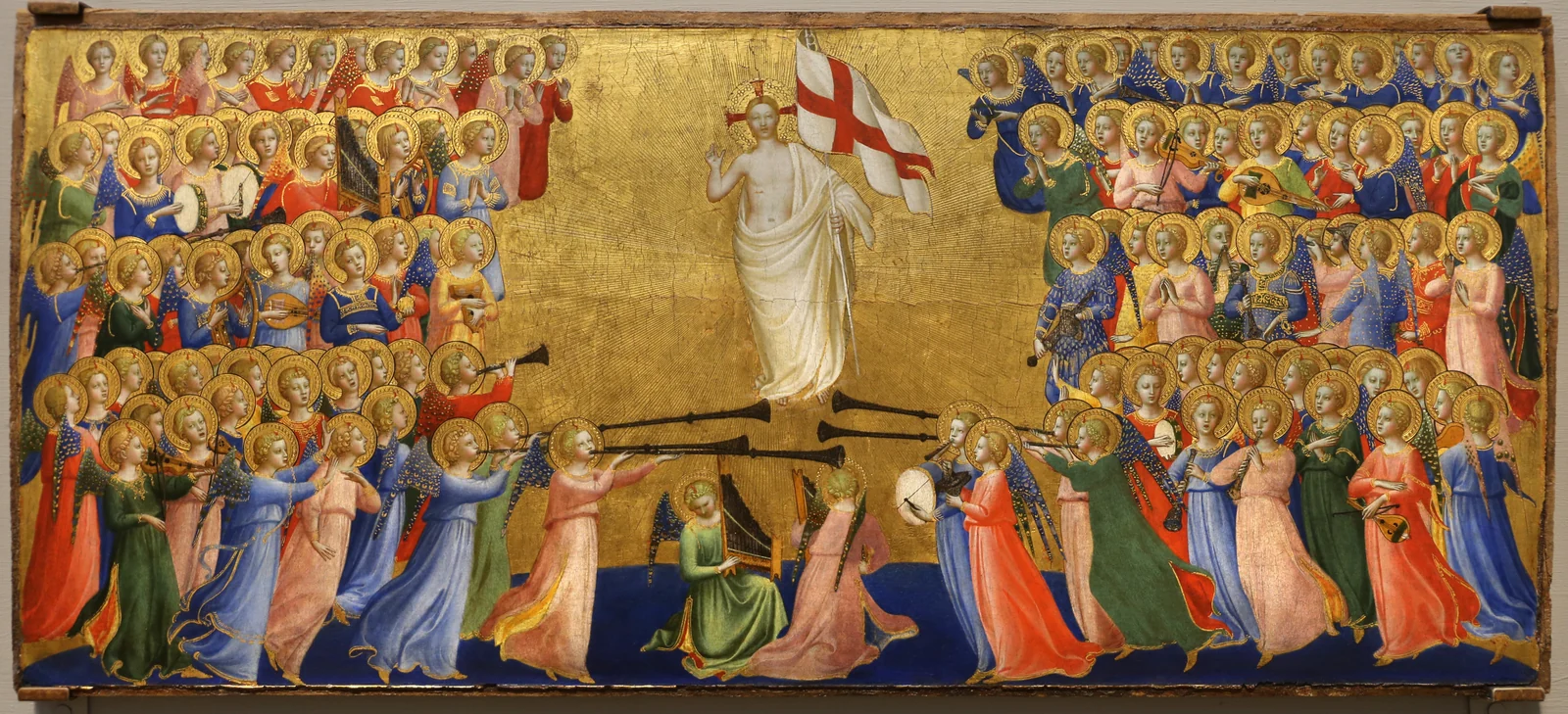
Matthew 16:18–19 · Revelation 21:12, 21, 25 · Revelation 15:2–4In Fra Angelico’s Christ Glorified in the Court of Heaven, painted around 1423–24, Christ hovers on wisps of cloud as angels sing, dance and play instruments around him. The painter scored lines into gold leaf to make light radiate from Christ. On the altar wall of the Sistine Chapel, Michelangelo’s The Last Judgement shows angels sounding trumpets and the dead rising before Christ the judge. One painting celebrates the risen Christ and the other depicts judgment, which is why their images of heaven look so different.
Fra Angelico’s painted panel at the National Gallery · Michelangelo’s fresco at the Vatican Museums